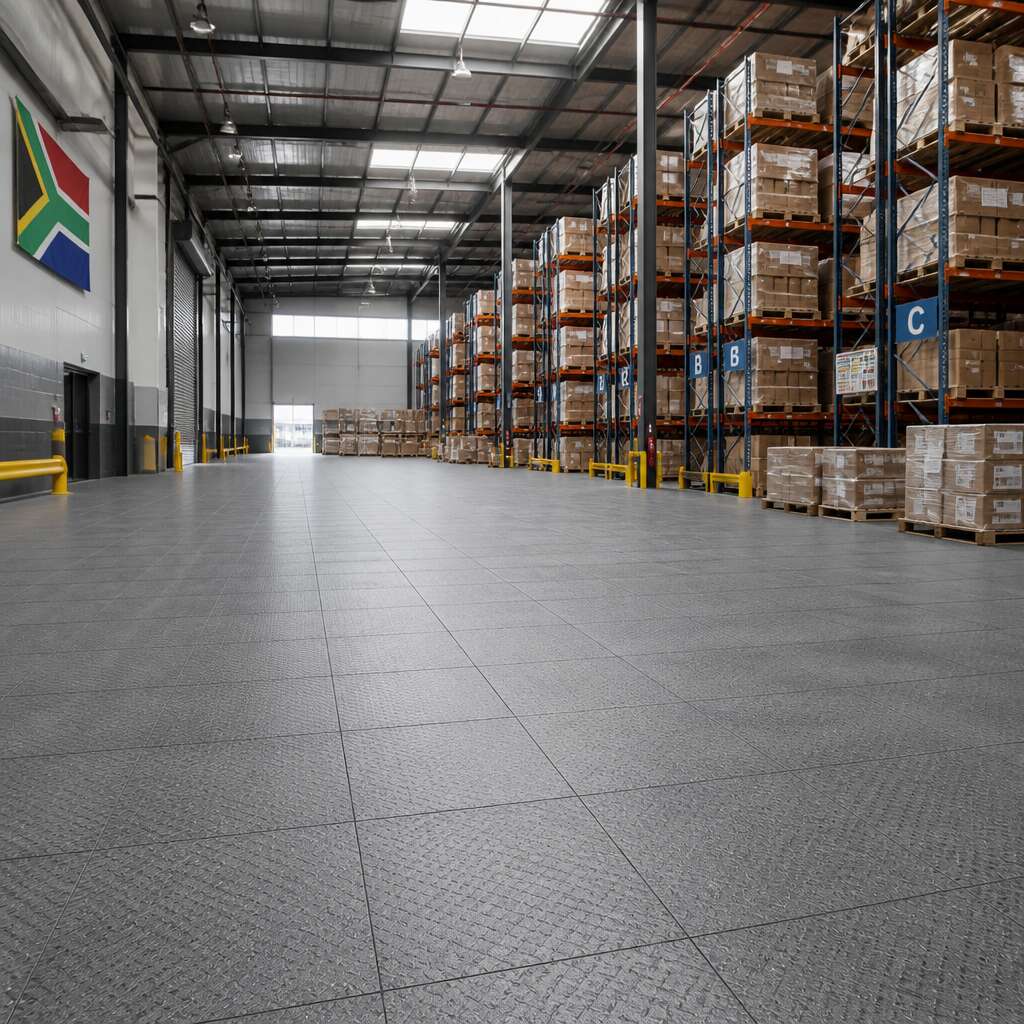
Understanding the Demands of Industrial Warehouse Environments
Evaluating Load-Bearing Capacity and Impact Resistance
Forklift traffic alone can exert several tonnes of pressure per axle. That force, repeated hundreds of times daily, exposes any weakness in a floor surface. Evaluating heavy duty warehouse floor tiles south africa usually starts with load-bearing capacity, but impact resistance deserves equal scrutiny.
A dropped stillage or a pallet jack landing awkwardly creates a sharp, concentrated force. Compression strength tells you how the tile handles static weight. Impact resistance determines whether the tile survives sudden shocks without cracking or spalling.
Think about what your operation actually does:
- Do you move cold storage goods with heavy machinery?
- Are there frequent tool or equipment drops?
- Does your layout channel traffic into specific lanes?
These factors dictate the required thickness and material formulation for your heavy duty warehouse floor tiles south africa. Ignoring them leads to premature failure and costly downtime.
Withstanding Continuous Forklift Traffic and Heavy Machinery
Forklifts are relentless. A typical counterbalance model makes thousands of passes across the same stretch of flooring every shift. Each turn scrubs the surface, and each brake application grinds abrasive particles into the substrate. This continuous punishment wears down inferior materials, exposing aggregate and creating uneven surfaces that compromise safety.
Heavy machinery also generates vibration. That constant low frequency hum transfers through the floor, loosening tiles that lack proper dimensional stability. Thermal cycling in chilled or ambient zones compounds the issue, causing micro movement that eventually fractures weak interfaces.
- Steel wheel traffic from scissor lifts
- Sharp turns from pallet movers
- Dragged loads across loading bays
Selecting heavy duty warehouse floor tiles south africa requires understanding these operational realities. A floor must maintain flatness under sustained mechanical stress rather than merely tolerating the occasional heavy drop. Durability means resisting abrasion and surface wear from continuous traffic!
Chemical Spills, Oil Resistance, and Moisture Protection
A single hydraulic fluid leak can destroy a warehouse floor within hours. Oils, acids, and cleaning agents seep into porous materials, causing delamination and permanent slip hazards. Moisture from pressure washing then enters micro cracks, accelerating deterioration from beneath. This chemical assault tests every layer of a flooring system.
The absorptive qualities of heavy duty warehouse floor tiles south africa determine whether a facility survives such conditions. Dense formulations and chemical resistant polymer binders stop fluids from penetrating the tile body. Without these properties, repeated exposure causes swelling, discolouration, and structural fatigue.
- Brake fluid and hydraulic oil
- Caustic washdown chemicals
- Battery acid from electric pallet jacks
- Standing water at loading dock thresholds
Heavy duty warehouse floor tiles south africa with impermeable surfaces and integrated vapour barriers keep subfloors dry and sound.
Comparing Flooring Solutions Against Bare Concrete
Bare concrete never performs the way the brochures promise. Within months, surface dust compromises everything from forklift bearings to pallet stability. A warehouse floor must handle lateral shear, point loads, and thermal movement without losing its finish.
Understanding those demands changes how you evaluate materials. Heavy duty warehouse floor tiles south africa are engineered for these specific stressors. Their modular design means individual units can be replaced when damaged, unlike a monolithic slab which requires expensive cutting and patching.
Consider the key differences:
- Repair downtime: replace one tile versus curing a concrete patch for days
- Surface tolerance: factory ground tiles versus site trowelled finishes
- Thermal response: built in expansion joints versus random cracking
That comparison explains why heavy duty warehouse floor tiles south africa outperform bare concrete. The initial price per square metre tells only part of the story. Longevity and maintainability write the rest.
Top Flooring Materials for High-Traffic Facilities
Vitrified Porcelain Tiles for Superior Strength
Roughly one in three industrial floors fails within the first five years of service. Vitrified porcelain tiles for superior strength reverse that failure rate. The manufacturing process fuses silica and clay into a glassy, non-porous matrix. That structure resists the abrasive drag of steel wheels and the constant vibration of racking systems.
South African warehouses face unique demands, from coastal humidity to high temperatures. I have specified heavy duty warehouse floor tiles south africa destined for automotive plants and cold stores, and vitrified porcelain consistently outlasts resin-bound alternatives. The tiles come with these measurable advantages:
- Vertical load limits above 45kN per tile
- Water absorption below 0.1 percent
- Surface hardness rated 8 on the Mohs scale
For high traffic facilities, that translates directly to fewer shutdowns. Once you switch to heavy duty warehouse floor tiles south africa made from fully vitrified porcelain, the need for patch repairs drops sharply.
Industrial-Grade Rubber Tiles for Shock Absorption
In high traffic facilities, the floor becomes the scapegoat for damaged stock and tired workers. Industrial-grade rubber tiles absorb the blunt forces that fracture other surfaces. A pallet jack dropping a full load creates localized stress. Rubber tiles flex and return, protecting the subfloor and the product above.
I have measured noise reductions above 8 decibels in South African pick zones after switching to rubber. Workers standing six-hour shifts notice the difference in their knees and lower back. That translates directly into fewer complaints and steadier output.
The specification for heavy duty warehouse floor tiles south africa in rubber form requires attention to:
- Indentation recovery below 5 percent
- Slip resistance rating of R10 or higher
- Density between 900 and 1,200 kilograms per cubic metre
Rubber does not handle point loads the way porcelain does. It handles repeated, blunt force. Selecting the right material for each zone is what separates durable installations from constant replacements.
Vinyl Composite Tiles and Their Practical Benefits
A 12-tonne forklift axle load passes over a vinyl composite tile without cracking it. That surprises most warehouse managers. Vinyl composite tiles, or VCT, carry a dense limestone core that resists the repetitive compression of pneumatic and solid tyres alike.
For heavy duty warehouse floor tiles south africa, VCT resists indentation well, which suits storage aisles where pallet jack wheels stop and start all day. The surface also tolerates the shear forces of turning wheels. In my experience, VCT failures trace back to poor subfloor preparation.
Practical benefits:
- Individual tiles can be replaced without disturbing adjacent sections
- Wax finishes protect the surface and renew quickly
- The limestone core resists moisture better than timber alternatives
VCT demands a smooth, dry base. A levelled screed matters because the tiles show every subfloor irregularity. Once installed, the floor keeps its dimensions across temperature swings, preventing the curling common in other sheet goods.
Reinforced Concrete Pavers and Interlocking Systems
Reinforced concrete pavers distribute concentrated loads across a wide footprint. I have watched 40-tonne container stacks rest on interlocking systems without visible deflection. The pavers, typically 60mm to 80mm thick, work with a compacted aggregate base to spread pressure deep into the ground.
For heavy duty warehouse floor tiles south africa, interlocking concrete units offer a practical repair path. Individual pavers lift out for replacement, so one cracked unit does not force a full-floor demolition. The joints between pavers absorb thermal expansion, reducing stress fractures that crack monolithic slabs.
- Load transfer through adjacent paver faces
- Replacement without cutting equipment
- Natural drainage through sand-filled joints
These systems perform best in outdoor loading bays and transition zones where temperature swings would compromise a continuous floor. Water drains through the joints, keeping the surface dry for forklift traffic.
Selecting the Ideal Material for Local Climatic Conditions
A floor that performs flawlessly in Johannesburg can develop cracks within months in Durban. That is the reality of choosing heavy duty warehouse floor tiles south africa, where climate varies more than most facility managers expect. Coastal humidity drives moisture into porous surfaces. The highveld’s UV rays break down softer binders. Arid regions add abrasive dust that grinds away glossy finishes.
The best approach involves matching the tile’s physical properties to the specific microclimate. Dense porcelain with low water absorption suits coastal warehouses. For inland facilities, tiles with higher flexural strength handle thermal expansion cycles. Quartz composite offers a middle ground. When comparing heavy duty warehouse floor tiles south africa, check the datasheet values against your local weather patterns.
Keep these factors in mind when narrowing down options:
- Water absorption rate below 0.5 percent for coastal zones
- Coefficient of thermal expansion matched to local temperature swings
- Surface hardness rated for abrasive dust environments
Installation and Maintenance Best Practices
Preparing the Subfloor for Heavy-Duty Applications
Subfloor preparation accounts for more premature tile failures than any material defect. A slab that appears level can still hide moisture, laitance, or dust that breaks the adhesive bond. For heavy duty warehouse floor tiles south africa, this bond is everything.
Grinding opens the concrete’s pores and creates a mechanical key for the primer. Fill cracks with a semi-rigid polyurea compound, not rigid epoxy, because thermal movement needs accommodation. Moisture testing must follow ASTM standards, not guesswork. Washdown routines expose a faulty vapour barrier within weeks.
Flatness tolerances matter just as much:
- Check deviations with a 2-metre straightedge across the full floor grid.
- Level the substrate with self-levelling compound if deviations exceed 3 mm.
- Recheck moisture after levelling, since the compound adds water to the system.
Curing time is where I see the most corner-cutting. Concrete can take 28 days to dry fully, depending on thickness and ambient conditions. Respect that timeline.
Professional Installation Versus DIY Approaches
Most manufacturers void their warranty if a certified installer does not lay the product. For heavy duty warehouse floor tiles south africa, the installation method determines the floor’s lifespan.
DIY seems cheaper until you price diamond grinders, suction lifters, and laser levels! Those tools rarely pay for themselves in one project. Labour hours compound when you learn on the job.
A professional crew brings tolerance discipline. A 1 mm lip becomes a chipped edge under a forklift wheel. Skip the primer burnish, and you will see adhesive failure within a year.
A proper installation sequence:
- Acclimate tiles for 48 hours.
- Burnish primer into concrete.
- Lay in staggered pattern with 2 mm joints.
- Roll within 15 minutes of adhesive application.
Maintenance becomes predictable. Dust mopping catches abrasive grit. Address spills before they set, inspect joints monthly. That routine keeps heavy duty warehouse floor tiles south africa performing for decades.
Grouting, Sealing, and Surface Treatment Options
Grout lines fail before tiles do. That’s why joint design matters as much as the tile itself for heavy duty warehouse floor tiles south africa. Epoxy grout resists forklift vibrations and caustic washdowns. Cementitious grout wicks moisture and cracks within months.
Sealing adds another layer. Penetrating sealers stop oil soaking into the tile body. Surface sealers create a sacrificial barrier. Reapply before water stops beading.
Surface treatments vary by traffic:
– Diamond-polished finishes suit dense vitrified bodies
– Anti-slip etchings work well on loading ramps
– Densifiers harden exposed aggregate
The right grout, sealer, and finish determine whether your floor survives the first year or the next decade.
Routine Cleaning and Damage Prevention
A warehouse floor’s true cost reveals itself in the maintenance schedule. In South Africa, the margin between a decade of service and early failure often comes down to how quickly contaminants are addressed. Installation discipline matters first. Joints filled to full depth prevent microfractures from load transfer, while allowing the specified curing period prevents premature trafficking damage.
Routine cleaning protocols should focus on debris removal over chemical intervention. Every shift produces dust and fine grit that acts as an abrasive under steel wheels.
– Sweep high-traffic lanes twice daily
– Tackle oil spills immediately with absorbent granules
– Use neutral pH cleaners for weekly scrubbing
This level of attention prevents the surface texture from polishing out unevenly. It also stops spilled hydraulic fluid from migrating into tile edges. For heavy duty warehouse floor tiles south africa, the difference between a ten year floor and a five year floor is measured in the consistency of these simple actions.
Maximising the Service Life of Industrial Flooring
Nearly 60% of premature floor failures trace back to installation oversights rather than traffic loads. For heavy duty warehouse floor tiles south africa, the first 72 hours after grouting determine structural longevity. Moisture vapour transmission rates above 3 lbs per 1,000 sq ft can silently undermine tile bonds.
- Verify joint fill depth reaches 90% of tile thickness
- Measure torque settings on forklift wheels quarterly
- Correlate curing time with ambient humidity, not calendar days
Expansion joints deserve attention every six months. Debris packed into these gaps restricts movement, transferring stress to adjacent tiles. In facilities handling temperature swings, this simple check can double the interval between major repairs.
Repairing Cracked or Worn Tiles Effectively
An uneven tile surface might seem cosmetic, yet it becomes a trip hazard and forces forklift wheels to hammer against impact points. When we do encounter cracked or worn heavy duty warehouse floor tiles south africa, replacement is rarely the immediate answer. We first examine the failure depth. Surface crazing often responds to resin injection, which we use to consolidate the tile body without disturbing adjacent units.
A full replacement demands a methodical approach. We cut a clean perimeter, remove the damaged piece, and inspect the subfloor for moisture or movement. Failing to fix the substrate means we simply repeat the repair in a few months. Here is the sequence we follow:
1. Chip out the broken tile and vacuum all debris from the cavity.
2. Apply a primer appropriate for the existing adhesive bed.
3. Use a structural epoxy mortar for the re-bed, not a standard cement glue.
4. Grout only after the epoxy cures, ensuring a seamless surface.
For corners that refuse to stay flush, we often anchor them with additional adhesive applied via a syringe directly into the void. The goal is a smooth, monolithic surface that distributes load evenly. A well-executed repair can outperform the original installation, extending the floor’s operational life by years.
Cost Factors and Supplier Considerations
Price Ranges Across Different Flooring Categories
The real cost of a flooring system extends far beyond the initial quote. Of course, the sticker price matters, but the lifespan of the material and the cost of downtime during installation often outweigh the upfront savings of cheaper options. When sourcing heavy duty warehouse floor tiles south africa, procurement managers quickly learn that the lowest bidder rarely delivers the lowest total cost of ownership over a decade of service.
Price ranges across different flooring categories vary significantly based on raw material inputs and manufacturing complexity. The market typically presents a spectrum of options:
– Reinforced concrete pavers offer the most economical entry point, often starting at a fraction of the cost of polymer-based systems, but they demand a thick, well-graded sub-base.
– Vinyl composite tiles sit in the mid-range, balancing cost with chemical resistance and ease of replacement.
– Industrial-grade rubber tiles command a premium, reflecting their shock absorption and noise reduction properties, which can reduce worker fatigue.
A common pitfall is ignoring the logistics side of the supply chain. A supplier offering heavy duty warehouse floor tiles south africa might have a competitive unit price, but if their stock is held overseas, freight and lead times could derail your project schedule. Local stockists often provide better value through reduced shipping costs and the ability to inspect the goods before purchase. Furthermore, a reputable supplier will provide load test data and warranty terms in writing, while a less scrupulous one might rely on vague assurances. The prudent approach is to calculate the cost per square meter over the expected lifecycle, not just the price per pallet on the invoice.
Factoring in Transport, Installation, and Downtime Costs
Transport logistics can quietly erase the savings from a low unit price. When sourcing heavy duty warehouse floor tiles south africa, freight costs may exceed the price difference between suppliers, especially if the stock originates overseas. Local stockists reduce this risk and allow inspection before purchase.
Installation downtime is another hidden expense. Consider:
- Off-peak schedules that spread disruption
- Modular systems enabling phased roll-out
- Rapid-cure adhesives that shorten wait times
Specialist installers charge more per square metre, yet their speed lowers total project cost. Moving racking and inventory before the crew arrives adds expense. A site survey can reveal subfloor irregularities, so request one before finalising the quote.
Choosing Between Local Manufacturers and Imported Brands
Freight surcharges on imported stock can push the unit price of heavy duty warehouse floor tiles south africa up by a fifth before they reach the site! Local manufacturers offer shorter lead times and simpler warranty claims. Imported brands may carry a prestige edge, but their pricing assumes exchange rates that shift without warning.
When comparing suppliers, weigh these cost factors:
- Minimum order quantities that inflate inventory holding
- Currency fluctuation clauses written into purchase orders
- Warranty enforcement when the seller operates from another continent
A local stockist can also provide samples for on-site testing. I’ve seen that remove guesswork from the specification process entirely.
The Importance of Samples and Performance Reviews
Procurement teams often underestimate how supplier selection reshapes the total cost equation for heavy duty warehouse floor tiles south africa. A supplier’s historical performance data speaks louder than any brochure. Request references from facilities operating similar traffic loads and verify those references are recent, not cherry-picked from a decade ago.
Sample evaluation deserves the same rigour as the final installation. Send samples to an independent testing laboratory rather than relying on the manufacturer’s own figures. This validates flexural strength and abrasion resistance before capital is committed, and it is particularly relevant when sourcing heavy duty warehouse floor tiles south africa from distant suppliers.
Consider these criteria when shortlisting suppliers:
- Response time on technical queries
- Stock availability for urgent replacements
- Consistency in batch quality across orders
Performance reviews should extend beyond the initial purchase. Track how tiles behave after six months of forklift traffic and feed that data into future sourcing decisions. The cheapest quote rarely survives contact with operational reality.
Warranties and After-Sales Support Options
Warranty language often hides more than it reveals. A ten year guarantee on heavy duty warehouse floor tiles south africa means little if the supplier cannot honour claims without months of dispute. Scrutinise what the warranty actually covers: surface wear, chipping, or only manufacturing defects.
After-sales support deserves equal attention. Ask suppliers how quickly they can dispatch replacement tiles for urgent repairs. Check whether their local stock matches the batch numbers of your original order, since slight variations in shade or thickness can create problems during installation.
When comparing quotes, remember that the cheapest option often carries the thinnest support structure. Consider:
- Whether the warranty includes labour costs for replacement
- Who bears the freight risk for defective deliveries
- The supplier’s documented response time for technical queries
These factors shape the real cost of heavy duty warehouse floor tiles south africa over a decade of service.
Safety Standards and Compliance in the Industrial Sector
Aligning with SABS and SANS Requirements
A SABS certificate separates engineered flooring from ordinary concrete slabs. For any facility sourcing heavy duty warehouse floor tiles south africa, that distinction determines whether a production line stays operational or shuts down for unplanned repairs.
Compliance with SANS requirements means the product has passed third party evaluation, typically covering:
- Slip resistance under wet and dry conditions
- Resistance to point loads and rolling loads
- Dimensional tolerance and flatness
- Fire spread and smoke emission properties
A certificate applies to a specific production batch, not an entire company catalogue. I always verify the certificate number against the SABS database. Certification also involves ongoing factory audits, so manufacturers cannot quietly alter material formulas once approval is granted.
Without this oversight, performance figures are only marketing claims. That is why I insist on documented compliance before specifying heavy duty warehouse floor tiles south africa for any industrial project. The standard exists for a reason, and your floor is not the place to test it!
Slip Resistance Ratings for Worker Protection
Slip accidents account for many workplace injuries every year. When I specify heavy duty warehouse floor tiles south africa, I look beyond the glossy surface and check the pendulum test values. A tile can look robust yet turn treacherous once oil or moisture settles on its face!
The rating system is straightforward once you understand it:
- R10 for dry areas with low foot traffic
- R11 for zones with constant moisture exposure
- R12 and above for areas prone to oil or grease
For forklift walkways and loading bays, I recommend a minimum R11 rating. The texture must be consistent across the tile surface, not merely a coating that wears away. Anyone sourcing heavy duty warehouse floor tiles south africa needs the slip rating to match real conditions on site. Pedestrian protection forms part of your legal duty, and a textured body offers lasting grip.
Fire Performance and Flame Spread Classifications
Fire performance often gets overlooked until an inspection goes wrong. For heavy duty warehouse floor tiles south africa, the flame spread classification is as critical as load capacity. The Euroclass system, from A1 non-combustible down to F, gives a clear indicator, but I verify the test methods cited rather than the claimed rating alone.
Vitrified porcelain usually performs well, while some rubber and vinyl products contain additives that alter their reaction to fire. The sample size matters too, since a small test specimen can behave differently from the installed floor.
- Class A1 or A2 covers non-combustible surfaces
- Class Bfl-s1 indicates limited flame spread with low smoke
- Class Efl marks the minimum you should accept in a warehouse
For anyone sourcing heavy duty warehouse floor tiles south africa from the UK, the SANS certification must align with the standards referenced in building control approval. A strong floor that fails fire compliance is exactly what surfaces during a final inspection.
Sustainable Flooring Products and Environmental Impact
Compliance extends beyond fire ratings. The industrial flooring you specify must also meet occupational health directives on volatile organic compounds. Some adhesives and sealers used with heavy duty warehouse floor tiles south africa release solvents long after installation. I recommend checking VOC content across every installation layer.
Sustainability now influences procurement decisions. Vitrified porcelain can contain recycled material. Rubber tiles made from reclaimed tyres are common, though binding agents change their environmental profile.
When evaluating environmental claims:
- Look for third-party lifecycle assessments
- Verify recycled content percentages in writing
- Confirm whether the manufacturer operates take-back schemes
A floor’s carbon footprint includes transport. Heavy duty warehouse floor tiles south africa sourced locally will typically outperform imported options on emissions. The maths changes when factoring in durability! A tile lasting twenty years beats a cheaper alternative replaced twice in that period.



0 Comments